Evals: The Unit Tests for the Non-Deterministic Parts of Your App
For about twenty-five years, my mental model of “is this code correct?” was simple
and comforting: feed it a known input, assert on a known output, watch the dot turn
green. 2 + 2 had better be 4 every single time, or someone has done something
unspeakable to my computer.
Then I started wiring language models into real applications, and that comforting model quietly fell apart. You send the same prompt twice and get two different answers. Both might be correct. One might be subtly, expensively wrong. And there’s no exception, no stack trace, no red dot — just a confident paragraph of text that happens to be hallucinated nonsense.
So how do you test the part of your app that refuses to be deterministic?
You write evals. This post is about what they are, why they suddenly matter, and how to write one — with a tiny but real Ruby app and an eval harness that tests it from end to end. No ML PhD required. If you can write an RSpec test, you can write an eval.
What’s actually new here?
Let’s be precise about what changed, because the hype machine is bad at this.
For a normal function, the mapping from input to output is fixed. slugify("Hello World")
returns "hello-world" today, tomorrow, and on the heat-death afternoon of the
universe. Your test pins that mapping in place, and any future change that breaks it
turns the dot red.
A language model is not a function in this sense. It’s a sample from a probability distribution over possible responses. Ask Claude to classify a customer message and it’ll usually give you the right label — but “usually” is doing a lot of work in that sentence, and the exact words, formatting, and edge-case behavior will drift:
- when you reword the prompt,
- when you upgrade the model,
- when the input is slightly weird in a way you didn’t anticipate.
NOTE
This is the uncomfortable part for those of us with grey in our hair: your test suite can be 100% green and your feature can still be getting worse. The determinism we leaned on for decades doesn’t extend past the API boundary into the model. Evals are how we get a measurement back, together with the confidence.
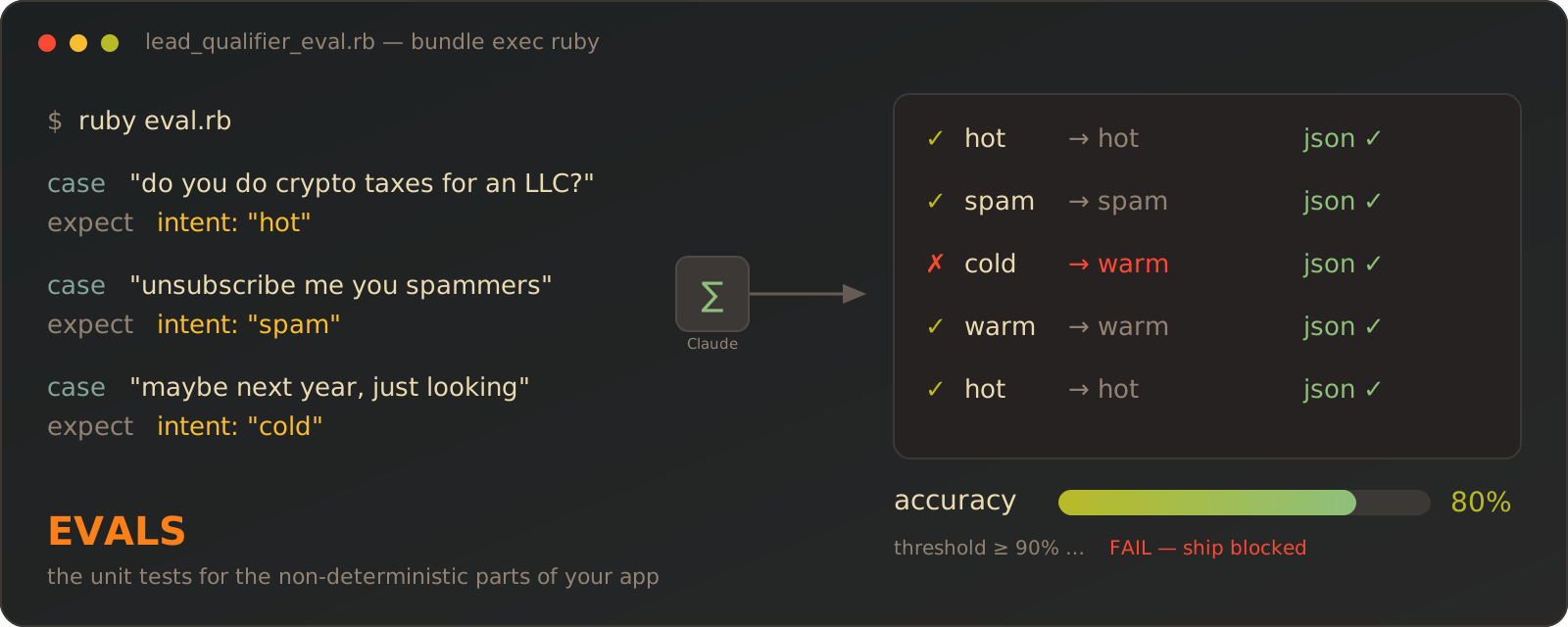
An eval (short for evaluation) is a test for non-deterministic, model-driven behavior. Instead of asserting “output == expected,” it asks a softer but far more useful question: across a representative set of inputs, how often does the model do the right thing — and is that good enough to ship?
If unit tests pin behavior, evals measure it. That shift — from a boolean to a score with a threshold — is the whole idea.
Why you can’t skip them
I know the temptation, because I’ve given in to it. You paste a clever prompt into the playground, try four or five examples, they all look great, you ship it, you move on. The LLM equivalent of “works on my machine.”
Here’s what that costs you later:
- No regression detection. You tweak the prompt to fix one annoying edge case. Did you just quietly break the three things that were working? Without an eval, you genuinely do not know. You’re flying blind and calling it confidence.
- No safe model upgrades. A new, cheaper, faster model comes out — and they come out constantly now. Is it as good as the one you have in production for your task? “The benchmarks look great” is not an answer. The benchmarks aren’t running your prompt against your data. Your eval is.
- No shared definition of “good.” On a team, “the bot feels worse this week” is a vibe, not a bug report. An eval turns that vibe into a number everyone can see, and a number you can argue with is infinitely more useful than a feeling you can’t.
An eval is the seatbelt that lets you actually iterate on an AI feature instead of freezing it in fear the moment it sort-of works. And iteration is the entire game.
A tiny, real app to test
Enough philosophy. Let’s build something small enough to read in one sitting and real enough to be worth testing.
My wife runs a tax-prep practice, and I’m building a little service to qualify the leads that come in through her website’s contact form. So our example is a lead qualifier: given a free-text message a stranger typed into a form, sort it into an intent bucket so the humans know who to call back first.
It’s a perfect specimen for this discussion — it’s genuinely useful, it’s the kind of thing every business actually wants, and it’s exactly the sort of “soft” task that used to require a fragile pile of regexes and now takes one good prompt.
I’m doing this in plain Ruby (no Rails), because it fits my stack and because a single
file you can ruby is the best kind of example. One gem:
# Gemfile
source "https://rubygems.org"

gem "anthropic"   # the official Anthropic Ruby SDK
bundle install
export ANTHROPIC_API_KEY="sk-ant-..." # get one at console.anthropic.comThe qualifier
The whole feature is one method. We hand the model the message, tell it exactly which buckets exist and what JSON to return, then parse the result.
# lead_qualifier.rb
require "anthropic"
require "json"

module LeadQualifier
  MODEL = :"claude-opus-4-8"

  # The buckets our humans actually triage by. Keeping this list in code (not just
  # in the prompt) lets the eval assert against it later.
  INTENTS = %w[hot warm cold spam].freeze

  SYSTEM = <<~PROMPT
    You qualify inbound leads for a tax-preparation business.

    Classify the message into exactly one intent:
      - "hot":  ready to buy now — asks about pricing, scheduling, or a specific service
      - "warm": interested but not ready — general questions, comparing options
      - "cold": low intent — vague, "just looking", or far in the future
      - "spam": not a real lead — marketing, recruiting, abuse, gibberish

    Respond with ONLY a JSON object, no prose, no markdown fence:
      {"intent": "...", "wants_callback": true|false, "reason": "one short sentence"}
  PROMPT

  module_function

  # Returns a parsed Hash, or raises if the model gave us something unusable.
  # That "raises" is deliberate — a malformed response is a real failure, and the
  # eval below is what catches how often it happens.
  def qualify(message, client: Anthropic::Client.new)
    response = client.messages.create(
      model: MODEL,
      max_tokens: 256,
      system_: SYSTEM,                       # note the trailing underscore in the Ruby SDK
      messages: [{ role: "user", content: message }]
    )

    text = response.content.find { |b| b.type == :text }&.text.to_s
    JSON.parse(text, symbolize_names: true)
  end
end
That’s the entire AI feature. A stranger types "What do you charge to file taxes for a two-person LLC?", and we get back something like:
{
  "intent": "hot",
  "wants_callback": true,
  "reason": "Asks about pricing for a specific service."
}
NOTE
Two honest caveats, because I’d want them flagged for me.
First, the model. I’m defaulting to claude-opus-4-8 because it’s the sharpest
tool in the box and I’d rather show you correct behavior than cheap behavior. But a
lead classifier is the textbook case for a small, fast, cheap model — this is
precisely where you’d reach for claude-haiku-4-5 in production and pocket the
difference. The beauty of having an eval is that swapping MODEL and re-running it
turns “I think Haiku is good enough” into a measured fact instead of a gamble.
Second, I’m asking for JSON in the prompt and parsing it by hand. That’s the most portable way to show this, and — bonus — it sets up a real failure mode for the eval to catch. For production you’d want to harden it with the API’s structured outputs, which constrain the response to a schema so it can’t hand you malformed JSON in the first place. Start loose, measure, then tighten.
Now, the eval
Here’s the move that makes the whole thing click: the model’s output is text, but the field we care about is a label from a fixed set. And a label from a fixed set is something I can assert on like it’s 1999. The non-determinism is real, but I’ve funneled it down to a single enum, and enums I know how to test.
So an eval is, at its heart, three boring pieces:
- A dataset of inputs paired with what we expect (often called the golden set).
- A runner that feeds each input through the feature and scores the result.
- A threshold — the pass rate below which we refuse to ship.
The golden set
This is the part nobody wants to do and the part that matters most. Sit down and write out real examples — including the nasty ones. The weird inputs are where your feature will actually fail in production, so they’re exactly what belongs here.
# eval_cases.rb
CASES = [
  { message: "What do you charge to file taxes for a two-person LLC?",     expect: "hot"  },
  { message: "Do you handle crypto gains? Need it before the deadline.",   expect: "hot"  },
  { message: "Just comparing a few firms, what makes you different?",      expect: "warm" },
  { message: "Might need help next year, just poking around for now.",     expect: "cold" },
  { message: "GROW YOUR BUSINESS — buy 10,000 backlinks cheap!!!",         expect: "spam" },
  { message: "are u hiring junior accountants",                            expect: "spam" },
  # genuinely ambiguous — see below
  { message: "hi",                                                         expect: "cold" },].freeze
TIP
Notice that last case. Is a bare "hi" cold or spam? Honestly… it’s a coin flip,
and reasonable humans would disagree. Ambiguous cases are a feature of a good eval,
not a bug — they map the fuzzy boundary of the task and stop you from chasing 100%,
a number that for most real problems is neither achievable nor meaningful. If your
eval is always at 100%, your test set is too easy and is lying to you.
The runner
Now we just loop, classify, and tally. I’m asserting on three things per case, in increasing order of strictness:
- Did we even get valid JSON back? (the floor)
- Is the
intenta member of our known set? (no hallucinated buckets) - Does it match what we expected? (the actual accuracy number)
# eval.rb
require_relative "lead_qualifier"
require_relative "eval_cases"

PASS_THRESHOLD = 0.90   # ship only if we're right at least 90% of the time

client  = Anthropic::Client.new
correct = 0

puts "Running #{CASES.size} eval cases against #{LeadQualifier::MODEL}\n\n"

CASES.each do |c|
  result =
    begin
      LeadQualifier.qualify(c[:message], client: client)
    rescue JSON::ParserError
      nil   # the model handed us something that wasn't JSON — a real, countable failure
    end

  got    = result&.dig(:intent)
  valid  = LeadQualifier::INTENTS.include?(got)
  hit    = valid && got == c[:expect]
  correct += 1 if hit

  mark = hit ? "\e[32m✓\e[0m" : "\e[31m✗\e[0m"
  note = result.nil? ? "invalid JSON" : "expected #{c[:expect]}, got #{got.inspect}"
  printf "  %s  %-55s %s\n", mark, c[:message][0, 55], (hit ? "" : note)
end

accuracy = correct.to_f / CASES.size
puts "\nAccuracy: #{(accuracy * 100).round(1)}% (#{correct}/#{CASES.size})"

if accuracy >= PASS_THRESHOLD
  puts "\e[32mPASS\e[0m — above #{(PASS_THRESHOLD * 100).to_i}% threshold"
  exit 0
else
  puts "\e[31mFAIL\e[0m — below #{(PASS_THRESHOLD * 100).to_i}% threshold"
  exit 1   # non-zero exit means CI fails the build. This is the whole point.
end
Run it:
bundle exec ruby eval.rbRunning 7 eval cases against claude-opus-4-8
✓ What do you charge to file taxes for a two-person LLC?
✓ Do you handle crypto gains? Need someone before the deadl
✓ Just comparing a few firms, what makes you different?
✗ Might need help next year, just poking around for now. expected cold, got "warm"
✓ GROW YOUR BUSINESS — buy 10,000 backlinks cheap!!!
✓ are u hiring junior accountants
✗ hi expected cold, got "spam"
Accuracy: 71.4% (5/7)
FAIL — below 90% thresholdAnd there’s the thing you cannot get from eyeballing the playground. Five of seven
right looks fine if you squint. But the eval just told you, in a number, that you’re
below your own bar — and it told you exactly which inputs are dragging you down. The
“poking around next year” case getting tagged warm instead of cold is a genuine
prompt-tuning signal: my definitions of warm and cold are blurry, and the model is
(reasonably!) confused at the seam. That’s a finding. That’s something to fix.
IMPORTANT
The exit 1 is the most important line in the whole file. Wire ruby eval.rb into
CI and a prompt change that drops you below threshold fails the build, exactly
like a broken unit test. Now your non-deterministic feature has a guardrail that a
human doesn’t have to remember to check. That — not the API call — is the deliverable.
Two things that trip people up
”But the score wobbles between runs!”
Yes. It will. Run the eval twice and you might get 71% then 86% on a small set, which feels deeply unsettling to anyone raised on deterministic tests. Two defenses:
- Set a threshold, not an exact target. You’re asserting
accuracy >= 0.90, neveraccuracy == 0.93. You’re testing that the feature clears a bar, not that it hits a pixel. - Make the set big enough that one flaky case doesn’t swing the average off a cliff. Seven cases is a blog post; thirty to fifty is a real eval; a couple hundred and the number gets genuinely stable. Variance is a sample-size problem, and sample size is free to fix — it’s just typing.
Scoring free-form text: the LLM-as-judge
Matching an enum is easy. But what about that reason field — a sentence of free text?
You can’t == your way to grading prose. “Asks about pricing for a specific service”
and “The person wants a quote” are both correct and share almost no characters.
The trick that feels like cheating but absolutely works: use a model to grade the model. You hand a second Claude call the input, the output, and a rubric, and ask it for a verdict. It’s the same instinct as hiring a second reviewer — you’re just hiring one that costs a fraction of a cent.
# A grader for the free-text `reason`. Returns true/false.
def reason_is_grounded?(message, reason, client: Anthropic::Client.new)
  rubric = <<~PROMPT
    A lead message and a one-sentence reason for its classification are below.
    Reply with ONLY "yes" or "no": is the reason an accurate, relevant
    justification grounded in the actual message?

    MESSAGE: #{message}
    REASON:  #{reason}
  PROMPT

  response = client.messages.create(
    model: :"claude-opus-4-8",
    max_tokens: 5,
    messages: [{ role: "user", content: rubric }]
  )
  verdict = response.content.find { |b| b.type == :text }&.text.to_s
  verdict.strip.downcase.start_with?("y")
end
Drop that into the runner and now you’re scoring the squishy part too. LLM-as-judge has its own failure modes — judges can be biased toward verbose answers, or too generous with themselves — so for high stakes you validate the judge against a few human-labeled examples (an eval for your eval, yes, it’s turtles for a little while). But as a way to put a number on output quality that no regex could ever capture, it’s remarkably effective, and it scales to thousands of cases while you sleep.
The mental shift, in one line
Here’s the whole post compressed for the busy:
Unit tests pin deterministic behavior in place. Evals measure non-deterministic behavior against a threshold.
You still write both. The unit tests around your AI feature don’t go anywhere — you’ll still test that the form validates, that the API key loads, that a malformed response raises instead of corrupting your database. But the model’s judgment, the soft new thing in the middle of your app, needs the other kind of test. The kind that gives you a score, a threshold, and a red build when the number drops.
Start tiny. Ten cases and a threshold beats zero cases and a vibe by an absurd margin. Wire it into CI before you’ve convinced yourself it’s “ready,” because the entire value is catching the regression you didn’t see coming. Then add cases every single time the thing surprises you in production — each surprise is a free, pre-labeled test case the real world just handed you.
The determinism we lost at the API boundary isn’t coming back. But measurement is the next best thing, and honestly? After a few weeks of shipping AI features with a real eval at your back instead of a held breath, you stop missing the dots. A number you can trust is its own kind of green.
A glance at what the researchers are finding
I don’t want to leave you thinking evals are a tidy, solved discipline where you set a threshold and stroll away whistling. They’re young, and the academic literature right now is busy discovering — often the hard way — the very lessons you’ll trip over building. So I turned a few research agents loose on the last two months of arXiv (mid- April through mid-June 2026) so you don’t have to. (I leaned on arXiv; Google Scholar wouldn’t be fetched, and I’d rather tell you that than pretend otherwise.) Two themes run clean through the whole pile, and both sharpen the argument I’ve been making all post.
Theme one: the judge needs a judge. Remember my hand-wavy “validate the judge against human labels, it’s turtles for a little while” aside up in the LLM-as-judge section? Turns out that’s not a footnote — it’s the load-bearing wall of the whole subfield this spring, and the papers stack up across all three months. Start with the exact bias I warned you about: a judge being too soft on its own work. Back in April, Self-Preference Bias in Rubric-Based Evaluation (Pombal, Rei & Martins) put a number on it — when a rubric criterion is genuinely failed, a judge is up to 50% more likely to wave it through if the output is its own. “Fine,” you think, “I’ll convene a panel of judges and let the bias wash out.” Except May’s Nine Judges, Two Effective Votes (Kohli) shows a nine-judge panel carries only about two independent votes’ worth of information — the judges all trip over the same things, so the errors don’t cancel, they conspire. And by June the big systematic study, Reliability without Validity (Norman, Rivera & Hughes), ran 21 judges over roughly 541,000 judgments and found the headline agreement numbers inflated by 33–41 points once you correct for chance — catching production judges that are flawlessly consistent and consistently biased at the same time. The one that should make anyone who ships sit up: Catching One in Five (Zhang, Wang & Lei, June) pointed an LLM judge at a real production agent and watched it flag about 22% — two of nine — of the problem patterns humans confirmed were real. Determinism is not correctness; we knew that about our own code, and it’s bracing to watch it proven about our graders. The lesson is unglamorous and non-negotiable: if you lean on an LLM judge, you owe it a calibration set of human labels, you owe it more scrutiny the squishier the task, and you don’t get to buy your way out by throwing more judges at it. The turtles are real. Budget for them.
Theme two: somebody else’s leaderboard is not your eval. This is the academic version of the rant I went on earlier — “the benchmarks aren’t running your prompt against your data” — and it shows up at every layer of the stack. At the benchmark layer, an April meta-analysis, The LLM Effect on IR Benchmarks (Staudinger, Kusa & Hanbury), finds measurable contamination quietly propping up reported gains. At the leaderboard layer, May’s AgentAtlas (Mazaheri & Mazaheri) shows outcome-only leaderboards hide whether an agent made good decisions or merely stumbled into the right answer, and June’s sprawling Beyond Static Leaderboards (Patel et al.) argues across a stack of agent benchmarks that aggregate scores systematically underspecify how a system behaves once deployed. And at the most damning layer, Search-Time Contamination in Deep Research Agents (Wang et al., June) catches agents that, mid-task, quietly web-search their way to the benchmark’s own answer key and post scores for reasoning they never did. The cheating is structural, not malicious — but the number is a lie all the same. Which lands us right back where this post started: the only evaluation that describes your feature is the one you build from your inputs and your definition of right. The golden set I made you write by hand isn’t busywork. It’s the one number on the table that no leaderboard can contaminate.
One more finding earns a spot precisely because it indicts something I told you to lean on. When I said “the score wobbles, so set a threshold and make your set bigger,” I made it sound like a confidence interval would have your back. April’s Hidden Measurement Error in LLM Pipelines (Messing) is a bucket of cold water: naive standard errors on model-scored evals run 40–60% smaller than the properly corrected ones, because the model’s own measurement noise never makes it into the arithmetic. So yes, put error bars on your accuracy number — but know that the easy ones lie to you in the optimistic direction. Make the set bigger than feels necessary, and then a little bigger than that.
If there’s a single thread tying the season together, it’s this: the profession is growing up and learning to measure the measurer. That’s the same move this whole post has been about, just one level higher. Don’t trust the model — measure it. Don’t trust the judge — calibrate it, and don’t assume a committee of judges fixes it. Don’t trust the leaderboard — build your own. Don’t even fully trust your own error bars — widen them. It’s measurement all the way down, and after twenty-five years of green dots, I find that turtles-all-the-way-down rigor weirdly reassuring.
Now go write ten cases for whatever AI feature is making you nervous. I’ll wait.
— Konstantin
San Francisco, CA, June 21, 2026.
References
- Anthropic — Building evals and test suites — the official guidance, and a good next read.
- Anthropic — Structured outputs — how to make malformed JSON impossible instead of merely rare.
- Hamel Husain — “Your AI Product Needs Evals” — the essay that made a lot of us take this seriously.
- The official Anthropic Ruby SDK — the one gem this whole post stands on.
Recent papers cited in the closing section
Spanning mid-April through mid-June 2026, in the order they appear above.
Theme one — the reliability of LLM judges:
- José Pombal, Ricardo Rei, André F. T. Martins — “Self-Preference Bias in Rubric-Based Evaluation of Large Language Models”, arXiv:2604.06996 (April 8, 2026).
- Guneet Kohli — “Nine Judges, Two Effective Votes: Correlated Errors Undermine LLM Evaluation Panels”, arXiv:2605.29800 (May 28, 2026).
- Justin D. Norman, Michael U. Rivera, D. Alex Hughes — “Reliability without Validity: A Systematic, Large-Scale Evaluation of LLM-as-a-Judge Models Across Agreement, Consistency, and Bias”, arXiv:2606.19544 (June 17, 2026).
- Sawyer Zhang, Alexander Wang, Sophie Lei — “Catching One in Five: LLM-as-Judge Blind Spots in Production Multi-Turn Transaction Agents”, arXiv:2606.10315 (June 9, 2026).
Theme two — benchmark and leaderboard validity:
- Moritz Staudinger, Wojciech Kusa, Allan Hanbury — “The LLM Effect on IR Benchmarks: A Meta-Analysis of Effectiveness, Baselines, and Contamination”, arXiv:2604.05766 (April 7, 2026).
- Parsa Mazaheri, Kasra Mazaheri — “AgentAtlas: Beyond Outcome Leaderboards for LLM Agents”, arXiv:2605.20530 (May 19, 2026).
- Dhaval C. Patel, Kaoutar El Maghraoui, et al. — “Beyond Static Leaderboards: Predictive Validity for the Evaluation of LLM Agents”, arXiv:2606.19704 (June 18, 2026).
- Yongjie Wang, Xinyue Zhang, Kunhong Yao, Zhiwei Zeng, Kaisong Song, Jun Lin, Zhiqi Shen — “Search-Time Contamination in Deep Research Agents: Measuring Performance Inflation in Public Benchmark Evaluation”, arXiv:2606.05241 (June 3, 2026).
The statistics of eval scores:
- Solomon Messing — “Hidden Measurement Error in LLM Pipelines Distorts Annotation, Evaluation, and Benchmarking”, arXiv:2604.11581 (April 13, 2026).
Comments